The Coin Jar Sort Kit
Pull the keepers first, sort a jar of US coins by the dates that changed their metal, weigh each lot, count the silver in troy ounces, read any offer per ounce, and put every keeper in a holder that fits
NumisNook's free tools each answer one question about one coin: its published diameter, weight and alloy, the grams of each metal in it, the holder that fits it, and how to store it. None of them starts where most people start: a jar, a tin or an inherited collection of mixed US coins, most of them worn, some of them silver, and one or two worth far more than their metal. Silver is priced per troy ounce, a kitchen scale reads a different ounce, and a jar holds six silver-bearing types at three finenesses. While writing this kit we checked our own tools and fixed three things: the Holder Size Finder rounded to the nearest size (a 19.05 mm cent got a 19 mm holder; it now rounds up), the Specification Reference's eras took in the 1943 steel cent and missed the wartime silver nickels, and the Metal Weight Calculator could report more metal than a coin weighs. The Coin Jar Sort Kit puts them in order. Handle by the edges and never clean; sort by the dates that changed each coin's metal; pull every coin that may be worth more than its metal before anything touches a scale; weigh each lot rather than count it; turn grams into troy ounces; and read any offer as dollars per ounce and as a share of melt. In the worked example (an example, not a promise), the 90% silver lots weigh 141.94 g and hold 4.1071 troy ounces, a little under the 4.1596 the face-value shortcut claims, and a kitchen-scale reading would have overstated them by 9.71%. Then every keeper goes in a holder rounded up, never down (the nearest size would have pinched 7 of the 12 example keepers), in a box with its silica gel worked out. It is metal-content arithmetic. Melt is the metal only, never a coin's collector value and never an appraisal, and nothing in the kit is investment advice. It never suggests melting a coin, and it says plainly that US law (31 CFR Part 82) prohibits melting, treating or exporting 1-cent and 5-cent coins, with limited exceptions. Specs are the US Mint's published figures, and worked figures are tagged as examples. Included: 23 printable pages with 7 steps, a sort sheet, a keeper log, an offer sheet, a fine-silver reference and a quickstart, plus a personalised sheet worked out from the numbers you entered in our calculators.
Look inside
Two full pages from the kit, exactly as printed. Click either to read it at full size before you decide.
What is in it
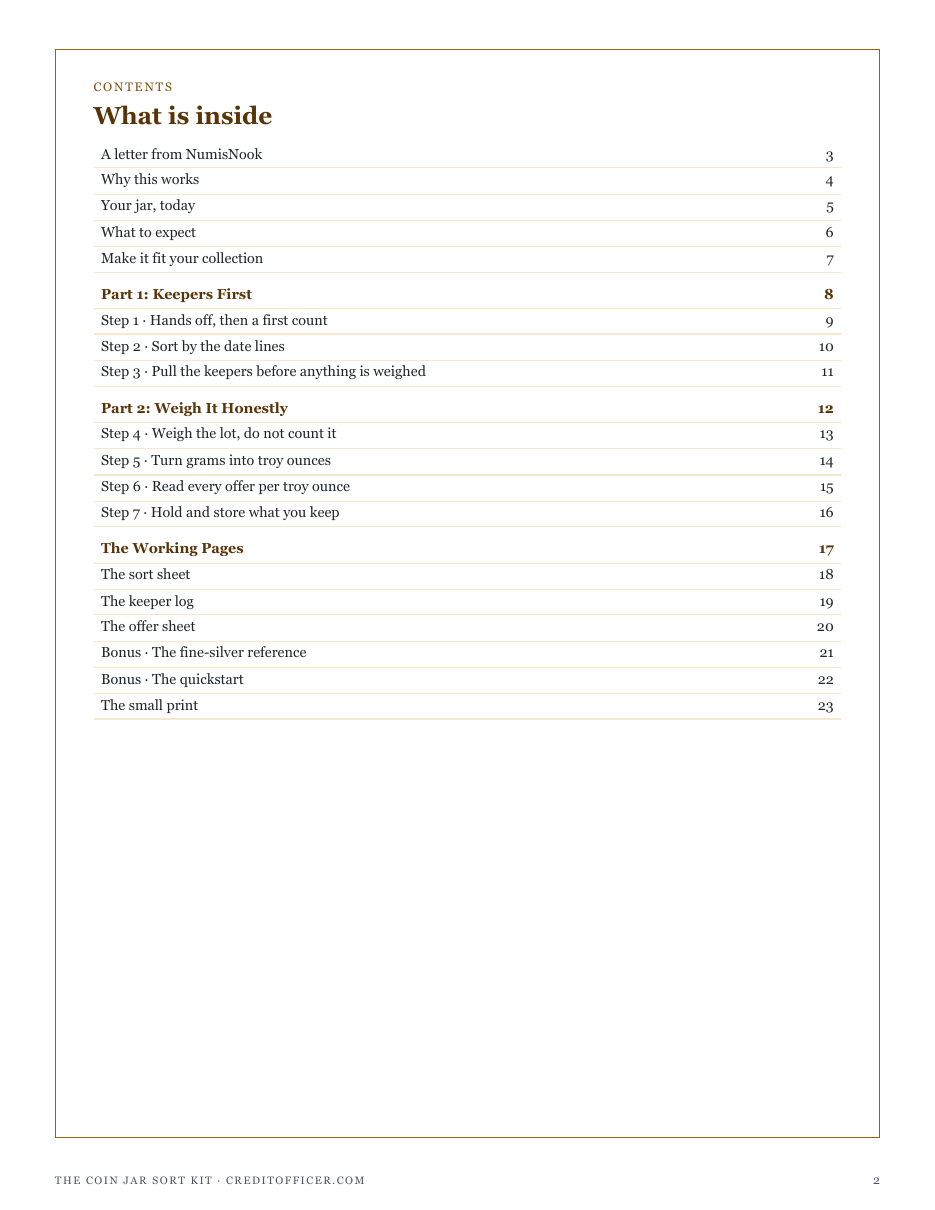
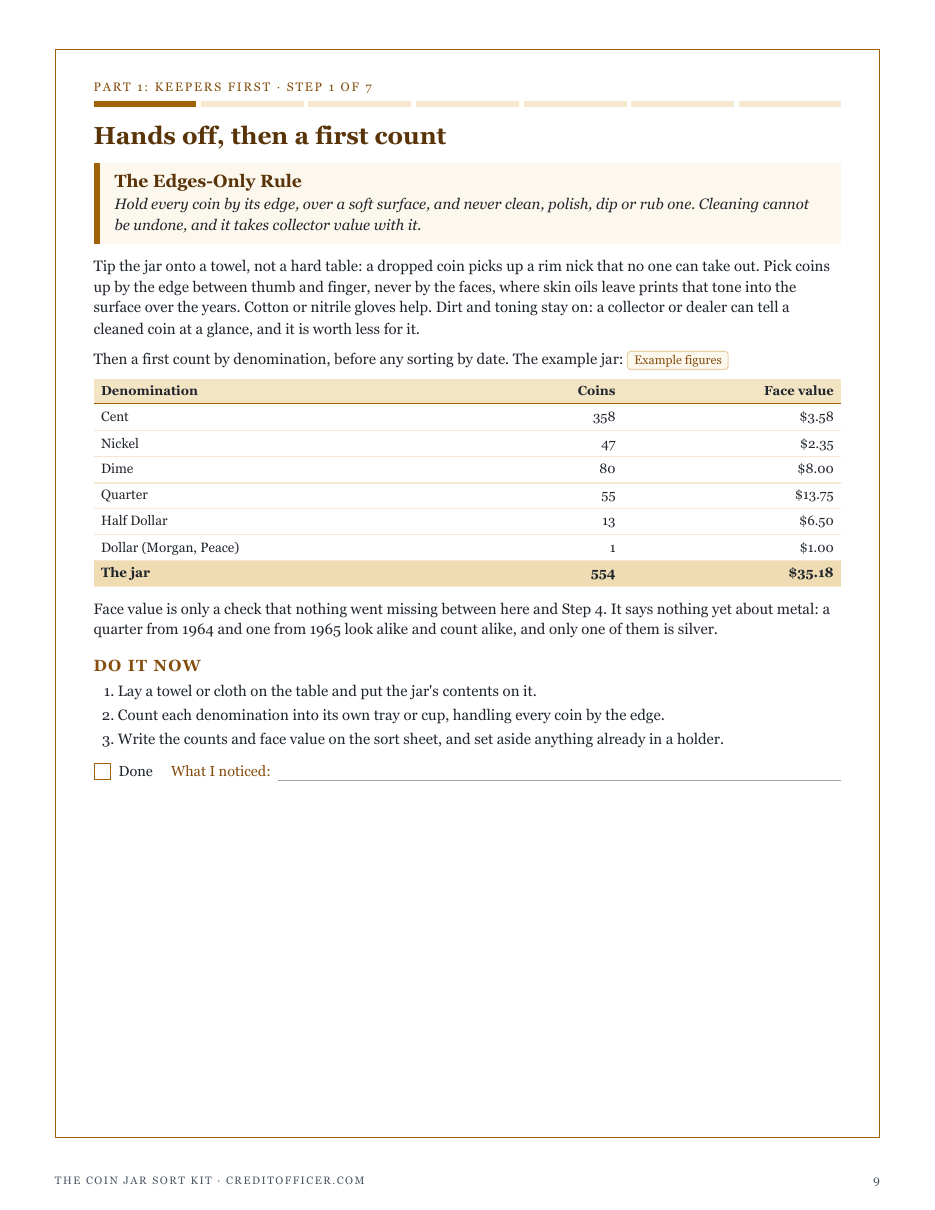
- The Edges-Only Rule: handle by the edges, never clean, and a first count of the jar by denomination and face value
- The Date-Line Rule: the dates that changed each coin's metal, with the silver in one coin of each bin
- The Keepers-First Rule: every coin that may be worth more than its metal leaves the pile before any scale, and why survivors, not mintage, decide
- The Weigh-the-Lot Rule: each silver lot weighed on a 0.01 g scale and multiplied by its fineness, against the count
- The Troy Ounce Rule: grams into troy ounces, the face-value shortcut and the kitchen-ounce trap
- The Per-Ounce Rule: any offer read as dollars per troy ounce and as a share of melt, and the law on cents and nickels
- The Round-Up Rule: every keeper's holder rounded up to the next standard size, a shopping list by size, and the box's silica gel
- The sort sheet and the keeper log, printable
- The offer sheet, printable
- A fine-silver reference for every US coin type in the table, and a one-page quickstart
- ✓ 23 printable pages
- ✓ 10 sections, worksheets and templates
- ✓ A second PDF worked out from the numbers you enter
- ✓ No account needed, just an email address
- ✓ Instant download; link valid 7 days
Price includes any taxes. Sold by GrabURL, who handle checkout and support. The charge appears on your statement as GrabURL.
The kit picks up where the free Coin Metal Weight Calculator leaves off. The calculator splits one coin's weight into grams of each metal; the kit starts from a jar of mixed coins. It pulls the coins that may be worth more than their metal before anything is weighed, sorts the rest by the dates that changed their alloy (using the US Mint figures in the Coin Specification Reference), weighs each lot, turns grams into troy ounces, and reads any offer as dollars per ounce. Then it puts every keeper in a holder from the Coin Holder & Album Size Finder, rounded up, in a box sized by the Coin Storage & Humidity Guide. Melt is the metal only, never a coin's collector value and never an appraisal, and nothing in the kit is investment advice. US law (31 CFR Part 82) prohibits melting 1-cent and 5-cent coins, with limited exceptions. Handle coins by the edges and never clean them. The worked figures are examples.